
- Published on
The 100-Day Micro-Journaling Challenge
You sit down at the end of a long day, exhausted, staring at a blank page. You tell yourself you’ll write a deep, reflective entry, but your brain feels like static. Five minutes pass, then ten. Eventually, you close the notebook, feeling like you’ve failed at yet another self-improvement goal.
We often imagine journaling as a laborious process—pages of flowery prose or soul-searching analysis. But here is the thing: the pressure to write a masterpiece is exactly why most people stop after three days. If your goal is to build a consistent habit, you have to lower the bar until it’s impossible to trip over.
This is where the 100-Day Micro-Journaling Challenge comes in. Instead of trying to capture your entire life, you focus on one single, meaningful moment per day. It’s not about volume; it’s about presence.
Why Less Is Actually More
Psychologically, the biggest barrier to habit formation is friction. When you make a task feel monumental, your brain’s natural response is to conserve energy and avoid it. This is known as the "cognitive load" of a habit. By limiting your writing to just one meaningful moment, you reduce that load to almost zero.
Research into gratitude and mindfulness suggests that it isn’t the length of the reflection that changes your neural pathways; it’s the consistency of the practice. When you spend 60 seconds identifying one specific highlight, you are essentially training your brain to scan your environment for positives throughout the day. You are actively searching for "the good" because you know you’ll need to write it down later.
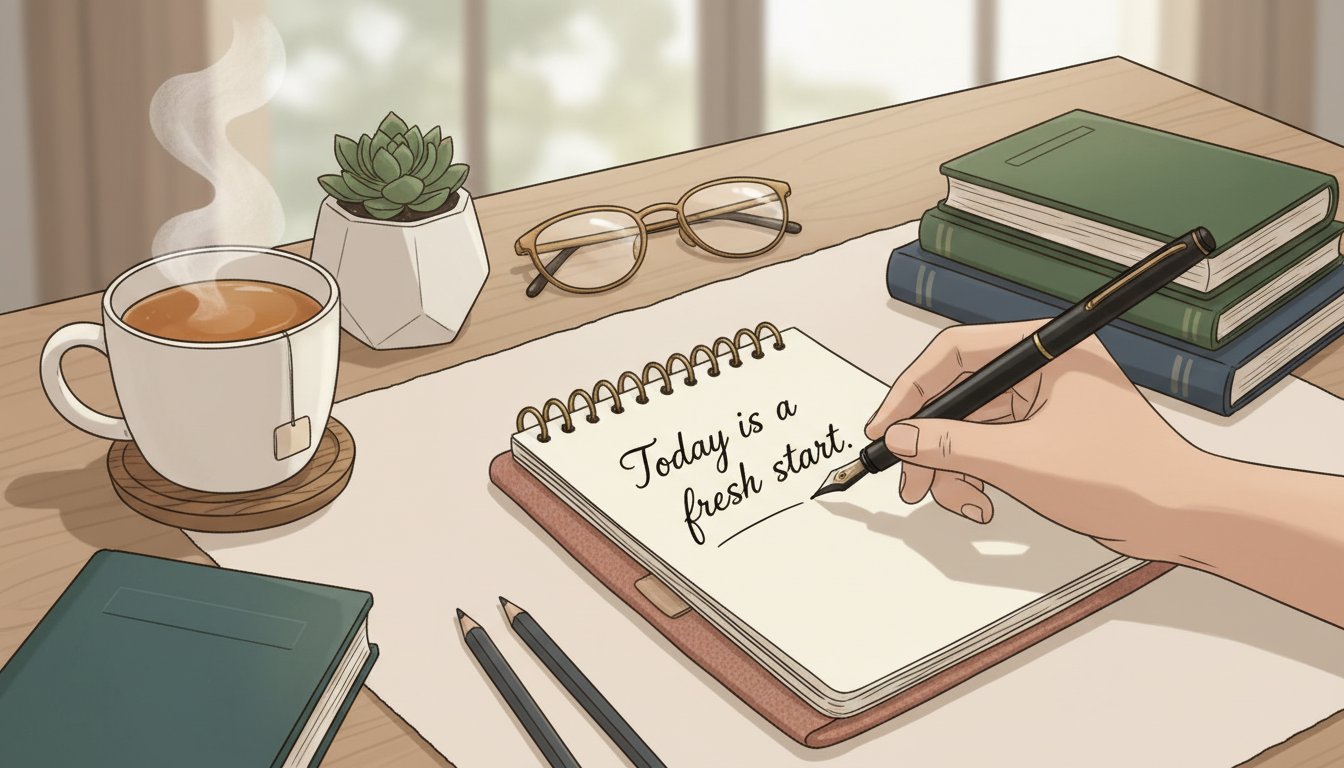
Designing Your Micro-Journaling Practice
To succeed in this 100-day journey, you need a simple framework. Without a structure, you might find yourself staring at the page again, wondering what counts as a "meaningful moment."
Keep it to three simple constraints:
- The Time Cap: Limit your writing time to two minutes. If you’re still writing after two minutes, you’re doing too much.
- The Specificity Rule: Don't write, "I had a good day." Instead, write, "I loved the way the sunlight hit the coffee shop table at 10:00 AM." Specificity builds memory.
- The Daily Anchor: Link your journaling to a habit you already possess. For example, do it immediately after you brush your teeth or the moment you set your phone down to go to sleep.
By setting a clear boundary, you remove the decision fatigue that usually kills new habits. You aren't "writing a journal"—you are simply recording one fragment of your day.
Using Streaks to Build Identity
There is a powerful psychological shift that happens around the 20-day mark of any consistent activity. You stop thinking of yourself as someone who is "trying to journal" and start identifying as "someone who journals."
This is where tracking becomes your greatest ally. When you see a chain of entries in your habit tracking tool, you’re creating a visual representation of your commitment. It’s hard to break a 30-day streak when you can see the progress staring back at you. That visual proof acts as a nudge on the nights when you’re tired and tempted to skip.

Think of your streak as a mirror. Each entry is a small vote for the person you want to become: a person who pays attention, a person who values their own experiences, and a person who shows up for themselves. If you happen to miss a day, don't let it derail your momentum. Acknowledge the gap, reset, and keep moving. The goal isn't perfection; it’s the cumulative effect of those 100 small moments.
Moving Beyond the 100 Days
Once you reach the 100-day milestone, you will likely notice that your perspective has shifted. You aren't just looking for moments to write down; you are living your life with more intention. You’ve essentially rewired your attention span to notice the small victories, the quiet beauties, and the subtle lessons that usually pass by unnoticed.
Many people find that after 100 days, they don't want to stop. They might expand their practice to two moments, or perhaps they begin to write a bit more comfortably. But the core habit—the ability to find meaning in the mundane—remains the foundation.
If you find yourself stuck or needing a push, remember that you are building a record of your life. In a year, or five years, these 100 moments will serve as a map of your personal growth, showing you exactly how you became the person you are today.
Key Takeaways
- Focus on micro-habits: By limiting yourself to one meaningful moment, you drastically reduce the friction that stops most people from journaling consistently.
- Prioritize specificity: Instead of vague reflections, capture concrete details. This makes the memory more vivid and the practice more rewarding.
- Use visual tracking: Seeing your progress in a habit tracking tool provides the motivation to keep your streak alive, transforming your daily effort into a clear, visual identity.
- Consistency over volume: A single sentence written every day is far more powerful for your brain than a long, sporadic essay written once a month.
- Start today: Don't wait for a "fresh start" or a new notebook. Grab a scrap of paper and write down one thing that happened today that made you feel alive. Your future self will thank you for the record you're creating.
If you're struggling to keep up with your daily goals, please reach out to a professional or a trusted person in your life for support. Otherwise, start your 100-day count today and watch how your perspective changes one moment at a time.
Build Better Habits — Track Your Streaks
Set goals, build streaks, and transform your life one habit at a time.