
- Published on
30-Day Social Confidence Challenge: Build Your Bravery
You’ve probably been there before. You’re standing in a crowded room, or perhaps just at a checkout counter, and you feel that familiar tightening in your chest. You want to speak up, tell a joke, or even just ask a simple question, but the "what-ifs" start flooding in. What if they think I’m weird? What if I stumble over my words? What if they just... don’t respond?
Social confidence isn't a magical trait that some people are born with while others are left in the shadows. It is a muscle. And just like any muscle in your body, if you haven’t used it in a while, it’s going to feel weak and shaky. The good news is that muscles respond to resistance. By intentionally putting yourself in slightly uncomfortable social situations, you can build a level of bravery that eventually feels like second nature.
This isn't about becoming the loudest person in the room or a world-class public speaker in a month. It’s about shrinking the gap between wanting to say something and actually saying it. Over the next 30 days, we are going to break down those walls, one small brick at a time.
The Psychology of Social Fear
The reason we feel social anxiety isn't because we are "broken." It’s actually an evolutionary survival mechanism. Thousands of years ago, being rejected by the tribe meant literal death. If you weren't liked, you were kicked out, and you couldn't survive the elements alone. Your brain still treats a "cringe-worthy" moment at a coffee shop like a life-or-death situation.
Here’s the thing: your brain is a bit of an over-dramatist. It uses a phenomenon called the "Spotlight Effect" to convince you that everyone is watching your every move, waiting for you to fail. In reality, most people are far too busy worrying about their own "spotlight" to notice yours. Research in behavioral psychology suggests that the best way to overcome this is through "progressive exposure." You don't jump into the deep end; you wade in until you realize the water is actually quite warm.

Week 1: The Micro-Interactions
In the first seven days, our goal isn't to hold long conversations. We are simply aiming to acknowledge the existence of other humans. This builds the foundation of "social presence."
Days 1-3: The Eye Contact and Smile. Your only goal is to make brief eye contact and give a small, polite smile to three people you pass on the street or see in a store. You don’t have to say a word. You are just proving to your nervous system that looking at people isn't dangerous.
Days 4-7: The "Time-Check" or "Direction-Ask." Ask a stranger for the time or for directions to a nearby landmark, even if you already know the answer. The goal here is to initiate a verbal interaction with zero stakes. You aren't trying to make a friend; you're just practicing the "ask."
Think about it this way: these micro-interactions are like stretching before a workout. They wake up the social centers of your brain without overtaxing your system. If you find yourself feeling overwhelmed, remember that you can track your progress daily to see how far you've come. Seeing a streak of seven successful days can be incredibly motivating when you're tempted to hide at home.
Week 2: Expanding the Comfort Zone
Now that you’ve broken the ice, it’s time to add a little more substance. This week is about "The Compliment and The Context."
Days 8-10: The Genuine Compliment. Find something you actually like about a stranger’s outfit, their dog, or even their choice of book. "Hey, those are cool sneakers," or "Your dog is so well-behaved!" then walk away. Giving a compliment and leaving immediately is a "power move" for confidence because it removes the pressure of having to maintain a conversation.
Days 11-14: The "Small Talk" Extension. When you’re at a checkout or waiting for an elevator, add one sentence to the standard greeting. If the cashier asks how you are, instead of just saying "Fine," say "I'm good, just looking forward to the weekend. Do you have any big plans?"
The real question is: why does this feel harder? It’s because you’re now inviting a response. You’re opening a door. This is where most people get stuck, but remember that even a "boring" interaction is a win. You aren't responsible for the other person’s mood; you are only responsible for your own bravery.
Week 3: Sharing Your Perspective
By now, you’ve realized that the world doesn't end when you speak to people. Week three is about moving from "reactive" social behavior to "proactive" behavior. You’re going to start sharing a bit of yourself.
Days 15-18: The Opinion Share. In a group setting—whether it's with coworkers, friends, or family—consciously share an opinion on a low-stakes topic. It could be about a movie, a restaurant, or a news story. Stop being the "agreeable" person who just nods. Your voice has value, and practicing this in a safe environment prepares you for the "wild."
Days 19-21: The "I’ve Been Meaning to Ask" Challenge. Reach out to someone you know but haven't spoken to in a while. Send a text or make a call. "Hey, I saw this and thought of you. How have you been?" This builds social "bravery" by overcoming the fear of being "annoying" or "out of the blue."
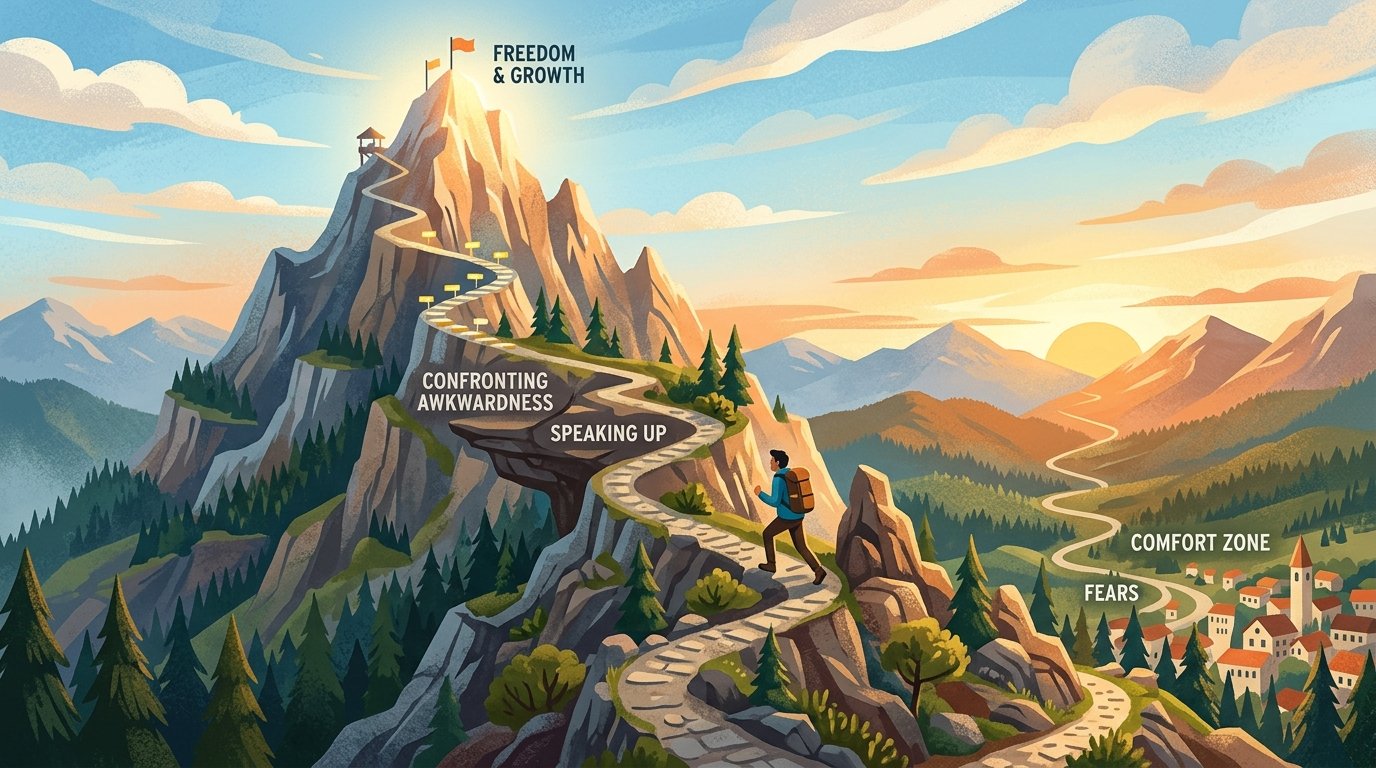
Week 4: The Bravery Zone
This is the final stretch. We are going to intentionally seek out situations where rejection is possible. Why? Because once you realize that rejection is just a "no" and not a "you aren't worthy," you become unstoppable.
Days 22-25: The "No" Hunt. Ask for something small that you might get a "no" for. Ask for a discount at a store (politely), ask for a seat at a crowded table, or ask a question in a public meeting. The goal is to get comfortable with the possibility of a "no."
Days 26-30: The Conversation Starter. Your final challenge is to start a conversation with a complete stranger and keep it going for at least two minutes. Use the "FORD" method (Family, Occupation, Recreation, Dreams) to find common ground.
At this point, you might notice something strange. The anxiety hasn't necessarily disappeared, but your relationship with it has changed. You’ve built a 30-day streak of showing up for yourself. Tracking your daily wins throughout this challenge can make the transformation feel more real. When you see 30 checkmarks in a row, it’s hard to tell yourself that you’re "not a social person."
Resilience and the "Bad" Interaction
Let’s be realistic. During these 30 days, you might have an interaction that feels awkward. Someone might be rude, or you might genuinely say something that doesn't land.
That said, one "bad" interaction does not negate 29 good ones. In fact, the awkward moments are the most important part of the challenge. They prove that you can survive a social "fail." You didn't melt, the ground didn't swallow you whole, and you woke up the next day. That realization is the ultimate source of confidence.
If you’re struggling with severe social anxiety that prevents you from functioning in your daily life, please reach out to a mental health professional or a trusted person in your life. This challenge is a tool for growth, but professional support is invaluable for deep-seated fears.
The Power of the Streak
The magic of a 30-day challenge isn't the 30th day; it’s the cumulative effect of the first 29. By the time you reach the end, you’ve rewired your brain’s "threat detection" system. You’ve replaced the habit of "hiding" with the habit of "engaging."
So what does this actually look like in the long run? It looks like being the person who can introduce themselves at a networking event without shaking. It looks like being the friend who brings people together. It looks like a life where you aren't limited by what you’re afraid to say.
Tracking your progress can help you stay consistent, especially on the days when you feel like staying in your shell. A visual reminder of your bravery can be the nudge you need to step out the door.
Key Takeaways
- Social confidence is a skill, not a trait. You can build it through progressive exposure and consistent practice over time.
- The Spotlight Effect is a lie. Most people are more worried about themselves than they are about your social "performance."
- Embrace the "no." Learning that rejection isn't fatal is the fastest way to build true bravery and resilience.
- Consistency is the secret sauce. Seeing your streak grow every day can be motivating and help you push through the initial discomfort.
- Start small and scale up. Don't try to give a speech on day one; focus on the smile and work your way to the conversation.
Build Better Habits — Track Your Streaks
Set goals, build streaks, and transform your life one habit at a time.