
- Published on
Stop Overthinking: A 30-Day Mental Clarity Challenge
You’re lying in bed at 2 AM, replaying a conversation from three years ago. Or maybe you’re staring at an email draft for twenty minutes, paralyzed by the fear that a single comma is out of place. We’ve all been there—trapped in a mental loop where the same thoughts spin around like a broken record, getting louder but never reaching a conclusion.
Overthinking feels like you’re doing "work," but it’s actually the opposite of productivity. It’s a drain on your energy, a thief of your time, and a major roadblock to your happiness. The truth is, you can’t think your way out of overthinking. You have to act your way out. If you’ve felt stuck in your own head lately, it’s time to hit the reset button.
The Psychology of the "Mental Loop"
Psychologists often refer to chronic overthinking as rumination. It’s a process where your brain gets stuck on a perceived problem, analyzing every possible angle without ever moving toward a solution. Research suggests that overthinking is often a misguided attempt at control. We believe that if we think about a problem long enough, we can prevent a bad outcome or find a "perfect" answer that doesn't exist.
The problem is that our brains aren't designed to handle the infinite "what-ifs" of modern life. When you overthink, you trigger your body’s stress response, making it even harder to think clearly. It’s a self-reinforcing cycle: the more you worry, the more stressed you feel, and the more stressed you feel, the more you worry. Breaking this cycle requires a deliberate shift in how you process your thoughts.
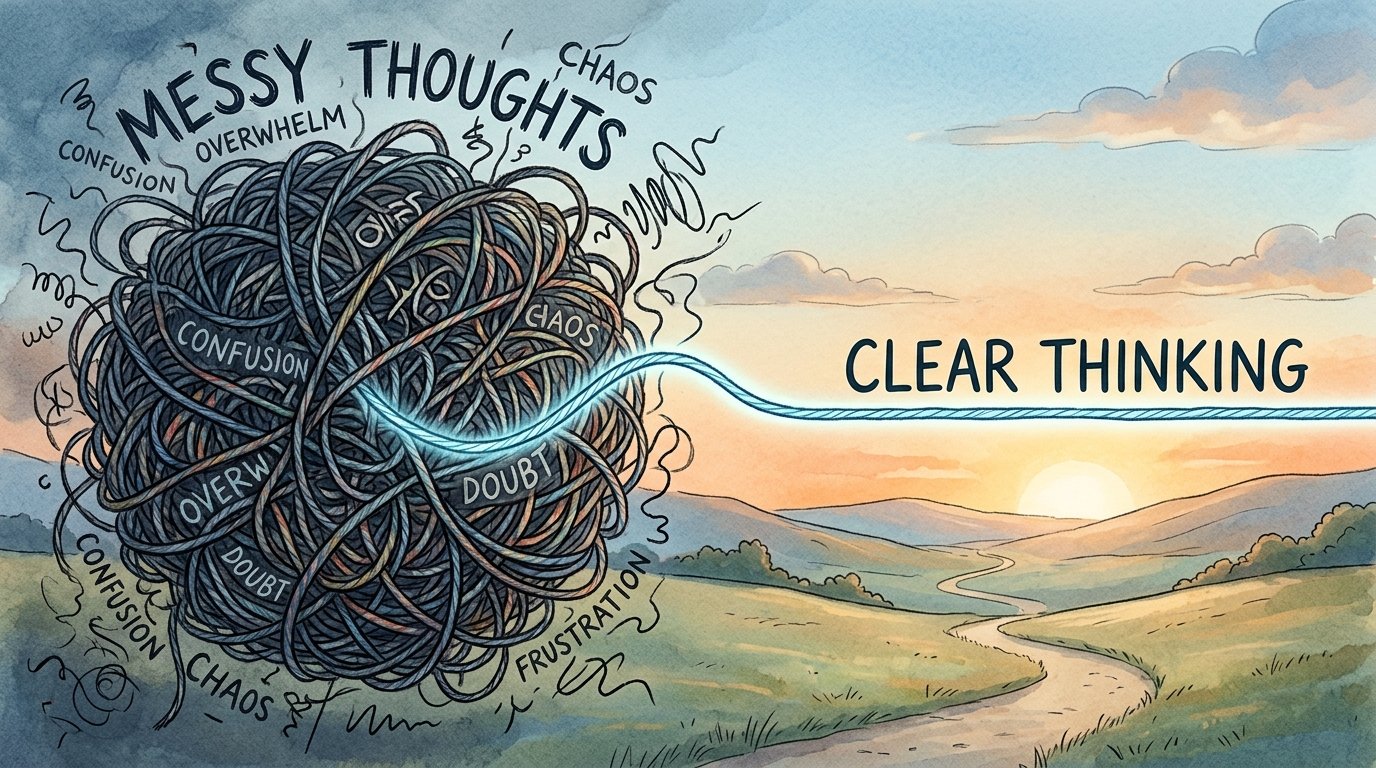
Phase 1: Awareness and Labeling (Days 1–7)
The first week of this challenge isn't about stopping the thoughts—that’s impossible. It’s about noticing them. You can't change a habit you don't realize you're doing. For the next seven days, your only job is to become an observer of your own mind.
Whenever you catch yourself spiraling, say it out loud or in your head: "I am overthinking right now." This simple act of labeling creates a small gap between you and the thought. You aren't the thought; you are the person noticing the thought.
Try to identify your "triggers." Does overthinking happen most at night? Does it happen when you’re looking at social media? By the end of the first week, you’ll likely notice patterns. Seeing your progress through a streak of "awareness wins" can be incredibly motivating. When you successfully catch a spiral before it goes too deep, acknowledge that win.
Phase 2: Distancing and Perspective (Days 8–15)
Once you’re aware of the habit, you need tools to create distance. During week two, we focus on "Cognitive Reframing." This is a technique used in cognitive behavioral therapy to challenge the validity of your thoughts.
Ask yourself two questions when a worry takes hold:
- Is this thought helpful?
- Is this thought based on facts or feelings?
Most overthinking is based on feelings (fear, shame, or anxiety) rather than objective facts. If a thought isn't helping you solve a problem or move forward, it’s just noise. Another powerful tool is the "5-Year Rule." Ask yourself: "Will this matter in five years?" If the answer is no, give yourself permission to stop thinking about it after five minutes.
Many people find that tracking their daily "clarity wins" helps during this phase. Seeing a visual representation of how many days you’ve successfully challenged your inner critic makes the process feel less like a chore and more like a game you’re winning.
Phase 3: The Action Pivot (Days 16–22)
By now, you’ve realized that thinking isn't solving the problem. Week three is about replacing "thinking time" with "action time." We use the 2-Minute Rule: If a thought leads to an action that takes less than two minutes, do it immediately. If it doesn't lead to an action, you must physically move your body to break the mental loop.

Go for a walk, do ten pushups, or wash the dishes. Movement shifts your brain’s focus from the "Default Mode Network" (where rumination happens) to the "Task Positive Network" (where action happens). You cannot easily ruminate while you are focused on a physical task.
Think about it this way: overthinking is like a car stuck in the mud. Revving the engine (thinking harder) just sinks you deeper. You need to get out and push (action) to get back on the road. During this week, try to maintain a streak of "action pivots." Every time you move your body instead of staying in your head, you’re rewiring your brain for better mental health.
Phase 4: Maintenance and Boundaries (Days 23–30)
The final week is about building a sustainable environment for mental clarity. This involves setting "worry windows"—a dedicated 15-minute block during the day where you are allowed to overthink as much as you want. When the 15 minutes are up, you’re done for the day.
If a worry pops up at 10 AM, tell yourself, "I'll think about that during my 4 PM worry window." This gives your brain the "control" it craves without letting the worry bleed into your entire day.
You should also look at your digital habits. Overthinking is often fueled by information overload. Use this week to set boundaries with your phone. A countdown to your "digital sunset" (the time you put your phone away for the night) can help your brain wind down and prevent those late-night bed-time spirals.
Staying Consistent Beyond Day 30
The goal of this challenge isn't to become a person who never has an anxious thought. That person doesn't exist. The goal is to become a person who knows how to handle those thoughts when they arrive.
If you’re struggling with deep-seated anxiety or intrusive thoughts that feel impossible to manage, please reach out to a professional or a trusted person in your life. There is no shame in seeking support for your mental well-being.
As you finish these 30 days, look back at how far you've come. The mental clarity you’ve gained isn't a fluke; it's the result of consistent, small choices. A countdown can make big goals feel more real, and seeing your progress on paper—or through a tracking tool—reminds you that change is possible. You have the power to step out of the loop and back into your life.
Key Takeaways
- Label the loop: Simply naming "overthinking" as it happens reduces its power over you.
- Fact over feeling: Challenge your thoughts by asking if they are helpful or if they are based on objective reality.
- Move to clear: When you’re stuck in your head, move your body to force a mental gear shift.
- Set boundaries: Use "worry windows" and "digital sunsets" to prevent thoughts from taking over your day.
- Track your progress: Seeing your streak grow every day can be motivating and helps solidify your new identity as someone who prioritizes mental clarity.
Build Better Habits — Track Your Streaks
Set goals, build streaks, and transform your life one habit at a time.