
- Published on
The 2-Minute Rule for Habit Stacking Made Easy
You’ve likely felt the sting of a abandoned New Year’s resolution. You start with high energy, promising yourself an hour of daily gym time or thirty minutes of meditation, only to find that life—work, family, exhaustion—gets in the way by day four. It is not a lack of willpower that stops you; it is the size of the hurdle you’ve set for yourself.
The secret to building lasting change isn't found in monumental effort, but in the microscopic adjustments you make to your daily schedule. By combining the 2-Minute Rule with the concept of habit stacking, you can turn daunting goals into automatic behaviors.
The Psychology of Starting Small
Our brains are designed to conserve energy. When you propose a massive change, like "reading for an hour every night," your brain flags it as a high-cost activity. It requires focus, time, and physical preparation, which makes it easy to procrastinate. This is where the 2-Minute Rule comes in. The rule suggests that any new habit should be scaled down to a version that takes two minutes or less to perform.
If you want to read more, don't aim for a chapter. Aim to read one page. If you want to exercise, don't aim for a gym session. Aim to put on your running shoes. By lowering the barrier to entry, you bypass the "friction" that causes most people to quit. Once you start, the hardest part—the initiation—is already complete. You aren't trying to build a habit; you are just showing up.
What Is Habit Stacking?
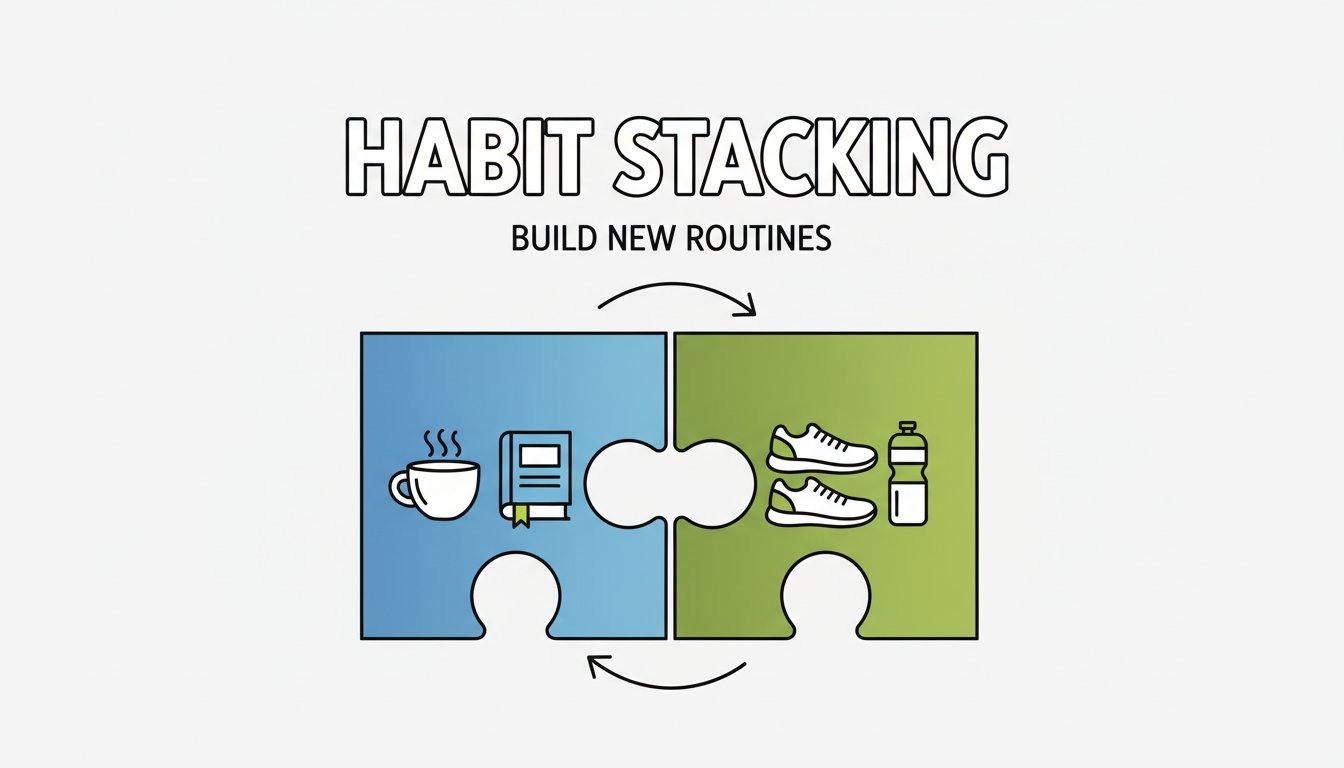
Habit stacking is the practice of pairing a new, desired behavior with an existing, automatic one. Think about your day like a chain of events. You probably already have a rhythm: you wake up, you brush your teeth, you make coffee, you check your email. These are your "anchor habits."
To build a new routine, you simply insert your 2-minute task immediately after an anchor habit. The formula is simple: "After I [Current Habit], I will [New 2-Minute Habit]." For example: "After I pour my morning coffee, I will write one sentence in my journal." Because you already perform the anchor habit with zero mental effort, the new behavior piggybacks on that established neural pathway.
Building Your Stack: Practical Examples
To make this work, you need to identify your existing anchors. These are the things you do without thinking. Let’s look at how you can apply this to different areas of your life.
For Physical Health
If you want to move more, use your post-work transition as your anchor. "After I take off my work shoes, I will do five bodyweight squats." It sounds trivial, but that is the point. You aren't trying to burn calories; you are trying to build the identity of someone who exercises daily. Once the habit is consistent, you can increase the duration. Many people find that tracking these small wins in a habit tracking app helps them see their progress over time, which reinforces the behavior.
For Mental Clarity
If you struggle with anxiety or racing thoughts, use your morning routine. "After I brush my teeth, I will practice deep breathing for two minutes." This creates a dedicated window for mindfulness that doesn't require a special room or a long commitment. It fits into the pockets of your day that are already occupied.
For Personal Growth
If you want to learn a new language or read more, link it to a meal. "After I sit down for lunch, I will review two vocabulary flashcards." By the time you finish your meal, you’ve already completed a task that brings you closer to your goal.
Why Consistency Beats Intensity
We often fall into the trap of thinking that progress must be visible immediately. We want the result today, not in six months. However, the science of behavior change suggests that frequency is more important than intensity. A 2-minute habit performed every single day for a year builds a much stronger neural connection than a one-hour habit performed sporadically.
Think of it as a streak. When you maintain a daily streak—even if it’s just for two minutes—you are consistently proving to yourself that you are the type of person who stays committed. If you find yourself struggling to stay on track, remember that seeing your progress visually can be incredibly motivating. Keeping a record of your daily wins transforms your goals from abstract wishes into concrete, measurable milestones.
Common Pitfalls and How to Avoid Them
The biggest mistake people make is trying to optimize too early. They start the 2-minute habit and, because it feels too easy, they immediately jump to 20 minutes. Don't do this. Stay at the 2-minute mark until the habit feels as automatic as brushing your teeth. If you make it too hard too soon, you reintroduce the friction you worked so hard to eliminate.
Another pitfall is forgetting the anchor. If your anchor habit is inconsistent, your stack will fail. If you try to stack a habit after "getting home from work," but you get home at different times every day, the cue is too fuzzy. Use specific, time-bound anchors like "when I turn off my alarm" or "when I close my laptop for the day."
If you are dealing with significant challenges regarding productivity or mental health, remember that small changes are a powerful starting point, but they are not a substitute for professional support. If you're struggling, please reach out to a professional or a trusted person in your life.
Key Takeaways
- Shrink the Goal: Use the 2-Minute Rule to make every new habit so small that it is impossible to say no to.
- Use Anchors: Identify your existing, automatic daily habits and use them as triggers for your new behaviors.
- Prioritize Frequency: Focus on showing up every single day rather than the intensity of the activity. Consistency creates the identity shift necessary for long-term success.
- Track Your Wins: Small progress becomes visible when you track it daily. Whether you use a journal or a digital tool, watching your streak grow provides the dopamine hit needed to keep going.
- Keep It Simple: Don't upgrade your habit until the 2-minute version is fully integrated into your life. Success is built on foundations, not intensity.
Build Better Habits — Track Your Streaks
Set goals, build streaks, and transform your life one habit at a time.