
- Published on
How to Build Habit Streaks with ADHD
You told yourself this time would be different. You bought a beautiful new journal, color-coded your habit tracker, and vowed to read for 20 minutes every single night. For four days, you were unstoppable. On day five, you forgot. On day six, the journal stayed closed. By day ten, the guilt set in, and the journal was buried under a pile of mail.
If you have ADHD, this cycle probably feels painfully familiar. Traditional habit-building advice is built for neurotypical brains. It relies on consistency, predictability, and a steady drip of dopamine that your brain simply does not have. But here's the thing: you can still build powerful, long-lasting habit streaks. You just have to change the rules of the game to fit how your brain actually works.
Why Traditional Habit Advice Fails the ADHD Brain
Let's look at the science of behavior change. Habits are governed by a region of the brain called the basal ganglia, which relies heavily on dopamine to create "habit loops" consisting of a cue, a routine, and a reward. In a neurotypical brain, successfully completing a small task provides a tiny hit of dopamine. Over time, this reinforces the loop until the behavior becomes automatic.
With ADHD, your brain has a chronic shortage of dopamine. It is constantly hunting for high-intensity stimulation, novelty, and immediate rewards. A simple, repetitive task—like flossing, doing the dishes, or drinking water—does not offer enough dopamine to sustain your interest. When the initial novelty of your new habit tracker wears off, your brain registers the task as boring, or even physically painful to initiate.
Additionally, ADHD brains struggle with executive function and object permanence. If you do not see your habit tracker, it ceases to exist. This is why traditional "do it every day or break the chain" systems often lead to frustration, shame, and immediate abandonment.
If you're struggling with severe ADHD symptoms or mental health challenges, please reach out to a professional or a trusted person in your life for support. Knowing how your brain works is the first step, but having a support system is just as crucial.
Redefining the "Streak" to Fit Your Mind
To make habit streaks work for you, we have to throw out the traditional rulebook. In classic tracking systems, a streak is a binary concept: you either did the habit, or you failed. If you miss a single day, your count resets to zero. For someone with ADHD, resetting to zero is a massive psychological blow. It triggers the "what the hell effect"—a cognitive bias where you feel that since the streak is broken, you might as well give up entirely.
Instead, try adopting a "flexible streak" mindset. Think of your streak not as a fragile glass chain, but as an elastic band. It can stretch, and it can bend, but it does not have to snap.
Let's break this down into practical tracking rules you can use.
The Grace Day Rule
Allow yourself one or two "pass" days per week where your streak count stays frozen instead of resetting to zero. This acknowledges that life with ADHD is unpredictable. Some days, your executive dysfunction will win, and that is completely fine. Keeping the streak frozen keeps your momentum alive.
Cumulative Weekly Tracking
Instead of tracking consecutive days, track your frequency within a larger window. For example, your goal might be to exercise four days out of seven. It does not matter which days you choose, as long as you hit the total by Sunday. This gives your brain the freedom to choose when to act based on your daily energy levels.
The Scaled Habit (The "Floor" vs. "Ceiling" Method)
Create a "micro" version of your habit for low-energy days. If your ideal habit (your ceiling) is to walk for 30 minutes, your micro habit (your floor) is to put on your sneakers and walk to the end of the driveway. Doing the micro version keeps the streak alive. It preserves the neural pathway without demanding high executive function.
Gamification and Visual Cues: Outsmarting Executive Dysfunction
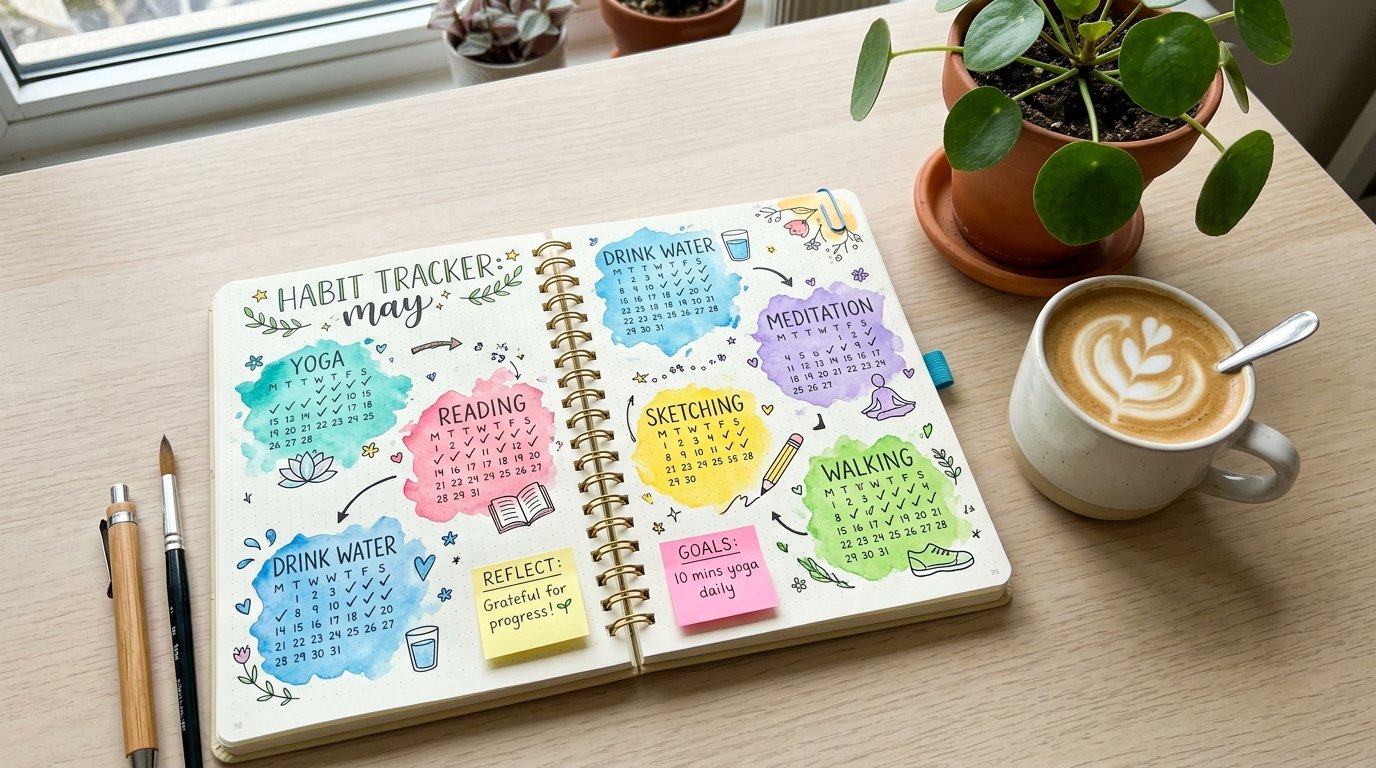
Since ADHD brains struggle with object permanence, your habits need to be highly visible. If your tracker is buried inside a folder on your computer or closed inside a desk drawer, you will forget it exists. You need to make your progress impossible to ignore.
Physical objects are highly effective for this. Try placing a clear jar on your desk and adding a marble to it every time you complete your habit. Seeing the marbles pile up provides a tangible, satisfying visual representation of your progress. The physical act of dropping the marble into the jar offers an immediate, sensory dopamine hit.
If you prefer digital solutions, choose visual habit tracking apps that allow you to place widgets directly on your phone's home screen. Every time you unlock your phone to check social media, your streak is staring back at you, acting as a gentle, non-judgmental reminder. Seeing your streak grow every day can be incredibly motivating.
But there's a catch. Even the most beautiful widget or physical jar can eventually blend into the background as your brain grows accustomed to it. Psychologists call this habituation. To prevent this "habit blindness," shake up your tracking method every few weeks. Swap your marble jar for a colorful dry-erase board on the fridge, change the theme of your digital widget, or switch up your daily reminder alarms. Novelty is pure dopamine for your brain.
How to Start a Habit When You Have Zero Motivation
When you have ADHD, the transition from "not doing the thing" to "doing the thing" is the hardest part. The mental friction of starting a task can feel like trying to push a boulder uphill. To bypass this resistance, you need to lower the barrier to entry and pair the habit with something you already love.
Temptation Bundling
This involves pairing a low-dopamine chore you need to do with a high-dopamine activity you want to do. For example:
- Only listen to your favorite comedy podcast while folding laundry.
- Drink your morning coffee only while writing down your daily schedule.
- Play your favorite upbeat playlist exclusively while doing the dishes.
By linking the boring task to an immediate reward, you train your ADHD brain to anticipate the pleasure, making task initiation much easier.
Body Doubling
Many neurodivergent people find it easier to complete tasks when someone else is in the room with them. You do not need the other person to help you with the task; their mere presence helps anchor your focus. You can use virtual body-doubling platforms, study streams, or simply call a friend while you clean your room or study.
How to Recover When Your Streak Breaks
Here is an inevitable truth: your streak will break. It happens to everyone, neurodivergent or not. The difference lies in how you handle the day after the break.
For people with ADHD, a broken streak often triggers a wave of self-criticism. You might think, See? I can never stick to anything. Why do I even try? This shame spiral is the ultimate progress-killer. It keeps you stuck in inaction for weeks or even months.
To break this cycle, you need a pre-planned recovery strategy.
First, reframe the break as data, not a personal failure. Ask yourself: Why did the streak break? Was I tired? Was the habit too big? Did I lose visual track of it? Use this information to adjust your environment. If you forgot to take your vitamins because they were in the cabinet, move them to the kitchen counter next to your coffee maker.
Second, focus on the "never miss twice" rule. Missing one day is an accident; missing two days is the start of a new, unwanted habit. If you miss a day, your only goal for tomorrow is to do the absolute smallest, micro-version of your habit. You do not need to do it perfectly. You just need to show up and log it. Tracking your progress can help you stay consistent, even when your motivation dips.
Key Takeaways
- Ditch the binary mindset: Traditional "all-or-nothing" streaks trigger shame spirals. Use grace days, cumulative tracking, and micro-habits to keep your momentum going.
- Fight habit blindness: Keep your trackers highly visible using physical jars, fridge boards, or phone widgets. Change your tracking style every few weeks to keep it feeling fresh.
- Lower the friction: Use temptation bundling and the two-minute rule to bypass the executive dysfunction that prevents you from starting.
- Plan for the break: Accept that you will miss days. When you do, use the "never miss twice" rule to get back on track without the shame. Small progress becomes visible when you track it daily, helping you build lasting self-trust.
Build Better Habits — Track Your Streaks
Set goals, build streaks, and transform your life one habit at a time.