
- Published on
Beat Parkinson’s Law with Countdown Timers
Have you ever noticed how a task that should take twenty minutes somehow eats up your entire afternoon? You sit down to write a simple email, but before you know it, you’re researching the history of the fountain pen, checking your fridge for the third time, and wondering where the last three hours went.
This isn't just a personal quirk; it’s a psychological phenomenon known as Parkinson’s Law. First coined by Cyril Northcote Parkinson in 1955, the law states: "Work expands so as to fill the time available for its completion." If you give yourself a week to finish a report, the report will take a week. If you give yourself two hours, you’ll somehow find a way to get it done in two.
The problem for most of us isn't a lack of talent or a lack of time. It's a lack of boundaries. Without a hard stop, our brains naturally drift toward complexity, overthinking, and distraction. We treat time like an infinite resource until we hit a crisis point. But what if you could manufacture that "last-minute" focus whenever you wanted?
The Psychology of the Ticking Clock
There is a reason we are so productive the day before we go on vacation. Suddenly, the "nice-to-haves" fall away, and we focus purely on the "must-haves." This is the "deadline effect" in action. When we know time is running out, our brains stop ruminating and start executing.
Psychologically, Parkinson’s Law thrives on the absence of urgency. When a deadline is far off, the "Prefrontal Cortex"—the part of your brain responsible for planning—gets lazy. It allows the "Amygdala" or the "Instant Gratification Monkey" to take over. Without a sense of scarcity, we don’t prioritize. We treat every minor detail as if it’s life-or-death, leading to perfectionism and burnout.
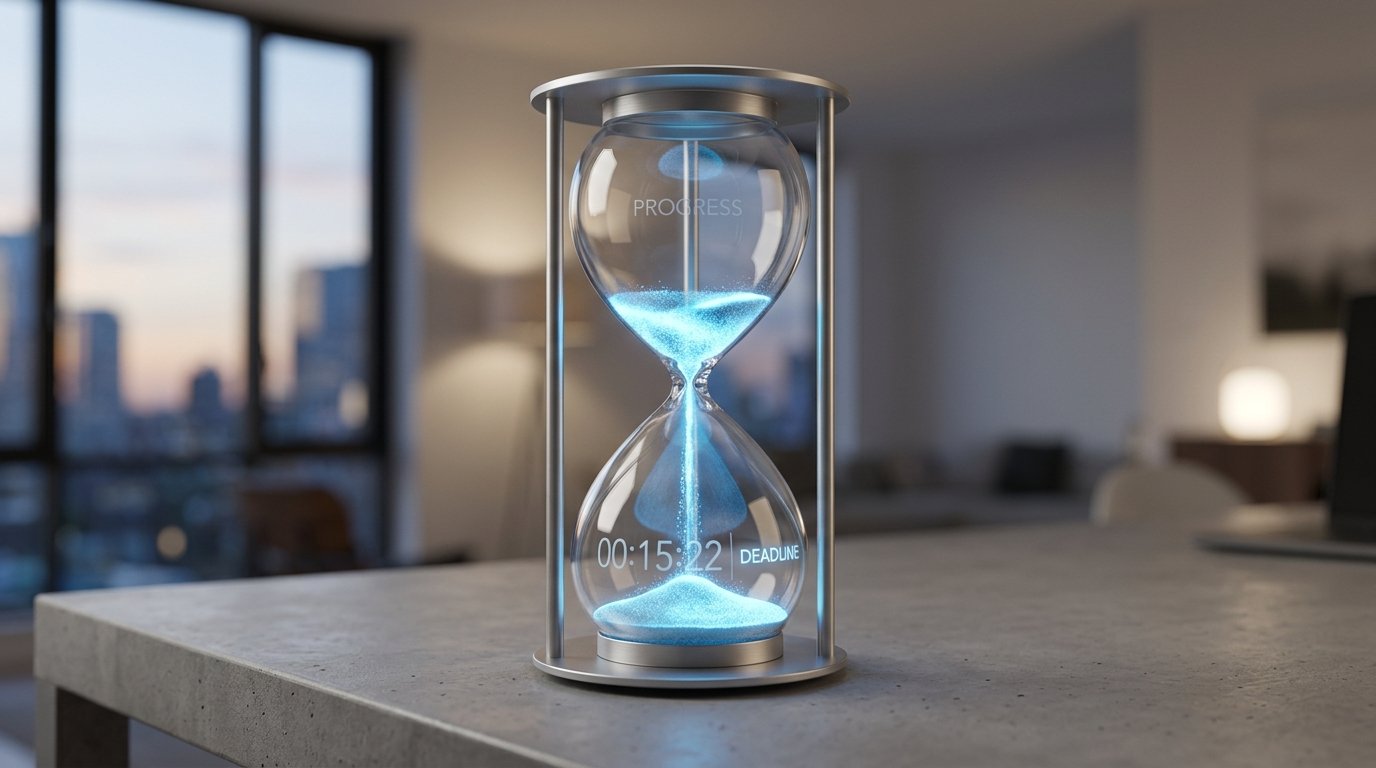
By using a countdown timer, you are essentially creating a visual boundary for your brain. You are telling your internal procrastinator that the "infinite" pool of time has been replaced by a finite box. This creates a healthy level of pressure that forces you to make decisions faster.

Why Countdowns Beat Traditional Clocks
You might think, "I have a clock on my wall; why do I need a countdown?" Here’s the thing: clocks tell you what time it is, but countdowns tell you how much life you have left for a specific task. There is a massive psychological difference between seeing "2:45 PM" and seeing "14:59... 14:58... 14:57."
A clock is passive. It’s just information. A countdown is active. It creates a sense of "loss aversion." Humans are hardwired to hate losing things more than we like gaining them. When you see those seconds ticking away, you feel the "loss" of your opportunity to work. This triggers a mild "fight or flight" response that sharpens focus and helps you ignore the urge to check your phone.
Setting "Aggressive" Boundaries
To truly beat Parkinson's Law, you can't just set a timer for the amount of time you think a task takes. You have to set it for the amount of time the task should take if you were focused.
If you usually take an hour to clean the kitchen, try setting a countdown for 25 minutes. You’ll be surprised at how much faster you move when the goal is to "beat the clock." This isn't about rushing or doing a poor job; it's about eliminating the "fluff" tasks—the staring out the window or the unnecessary re-organizing—that usually fill the gaps.
How to Implement Countdowns in Your Daily Life
You don't need a complex system to start using this. In fact, the simpler the better. The goal is to make the countdown a visible part of your environment so your brain can't ignore it.
1. The 10-Minute Sprint
If you’re facing a task you absolutely dread, tell yourself you’ll only do it for 10 minutes. Set a countdown for 10:00 and hit start. Often, the hardest part of Parkinson’s Law is the "entry cost"—the mental energy required just to start. Knowing there is a hard stop in ten minutes lowers the barrier to entry. Usually, once the timer goes off, you’ve built enough momentum to keep going.
2. Time-Boxing Your "Admin"
Small tasks like checking emails, paying bills, or filing digital photos are the ultimate victims of work expansion. They are low-stakes, so we let them linger. Dedicate one hour a day to "Admin," but instead of just working until you’re done, set a countdown. When the timer hits zero, you stop. This forces you to handle the most important messages first rather than getting stuck in a thread from three years ago.
3. Visualizing Long-Term Goals
Parkinson’s Law doesn't just apply to daily chores; it applies to your life goals. If you say, "I’ll start my business someday," that "someday" will expand to fill your entire life. Using countdown tools to track the days until a major milestone—like a product launch, a marathon, or a move—makes the future feel real. Seeing that you have "45 days left" creates a different level of urgency than saying "sometime next month."
Overcoming the "Perfectionism" Trap
Perfectionism is just Parkinson’s Law in a fancy suit. We tell ourselves we’re being "thorough," but usually, we’re just afraid of being finished. When we’re finished, our work can be judged. As long as we’re "still working on it," we’re safe.
A countdown timer acts as a "forced completion" mechanism. It gives you permission to be "good enough" for now. When you have five minutes left on the clock to finish a presentation, you stop worrying about the font size on slide 12 and start making sure the conclusion actually makes sense.
Think about it this way: a finished project that is 80% perfect is infinitely more valuable than a 100% perfect project that never leaves your hard drive. Tracking your progress through streaks or daily countdowns helps reinforce the habit of finishing what you start.
Dealing with "Time Blindness"
Many people, especially those with ADHD, struggle with "time blindness"—the inability to sense how much time has passed. For a time-blind person, an hour can feel like five minutes, or five minutes can feel like an hour.
Countdowns provide an external "prosthetic" for your internal clock. They provide a constant, objective feedback loop. If you find yourself constantly running late or missing deadlines, try using a countdown for the time you have left before you need to leave the house. Seeing "15:00" on a screen in your hallway can be the difference between leaving on time and being twenty minutes late.
Using a countdown tool or a dedicated habit tracking app can help you visualize these blocks of time. Seeing your "days since" a bad habit or your "days until" a big goal provides the structural support that a wandering mind needs to stay on track.
Staying Consistent Without Burnout
While countdowns are powerful, they are a tool, not a slave driver. The goal isn't to live every second of your life under the pressure of a ticking clock. That’s a one-way ticket to anxiety.
The secret is to use countdowns for the "deep work" and the "dreaded work." Use them for the tasks that tend to bleed into your personal life. By using a timer to finish your work by 5:00 PM, you are actually protecting your rest. You are ensuring that when you sit down to dinner, you aren't still thinking about the work you "should" have finished three hours ago.
Consistent progress is about rhythm. Use the countdown to create a high-intensity interval of focus, then follow it with a period of total relaxation. This "sprint and recover" method is much more sustainable than the "marathon of distraction" most people engage in.
Key Takeaways
- Define the Boundary: Work will always expand to fill the time you give it. If you don't set a limit, the task will take forever.
- Use Visual Urgency: A countdown timer creates a sense of scarcity that a regular clock cannot match. It triggers the "deadline effect" on demand.
- Start Small: Use "10-minute sprints" to overcome the initial resistance to starting a difficult or boring task.
- Focus on Finishing: Use countdowns to kill perfectionism. Done is better than perfect, and a timer forces you to make the final call.
- Track Your Progress: Whether it's a daily streak or a countdown to a big life event, keeping your goals visible helps maintain long-term momentum. Tracking your progress can help you stay consistent over the long haul.
By reclaiming your time from Parkinson’s Law, you aren't just getting more work done. You’re gaining more freedom. When you control the clock, the clock stops controlling you. Start today by picking one task, setting a timer for 20% less time than you think you need, and seeing what happens when the countdown begins.
Build Better Habits — Track Your Streaks
Set goals, build streaks, and transform your life one habit at a time.