
- Published on
Beat Exam Anxiety: Countdown Timers and Study Streaks
You are staring at a blank document, the cursor blinking like a tiny, mocking metronome. Your final exam is in 14 days. You know you need to study, but every time you open your textbook, your chest tightens, your palms sweat, and a strange, paralyzing fog settles over your brain. Instead of reading, you find yourself cleaning your room, scrolling through social media, or staring blankly at the wall.
Here's the thing. You are not lazy. You are experiencing exam anxiety, and your brain is currently in a state of active avoidance. When an upcoming test feels like a massive, looming threat, your nervous system responds the same way it would to a physical danger: it wants to run away. Procrastination is not a time-management problem; it is an emotional regulation problem.
To beat this paralysis, you need to change how your brain perceives the threat. By combining the psychological power of countdown timers with the momentum of daily study streaks, you can lower your anxiety, find your focus, and build a sustainable learning routine that lasts long after finals week is over.
The psychology of exam panic: Why we freeze
When you think about a massive exam, your brain struggles to process the sheer scale of the task. "Studying for chemistry" is too vague, too big, and too emotionally charged. Your amygdala—the brain's alarm system—takes over, triggering a fight-or-flight response. Since you cannot fight the textbook, you flee from it by doing literally anything else.
This is where cognitive overload happens. You feel like you have an infinite amount of work to do, but a highly finite and rapidly shrinking amount of time to do it. The uncertainty of the future creates a state of chronic anxiety.
To break this cycle, we have to reduce the cognitive load. We do this by making time visible and making progress tangible. When you anchor your mind to concrete numbers, the abstract fear begins to shrink.
If you're struggling with severe anxiety, panic attacks, or prolonged mental distress during exam season, please reach out to a professional or a trusted counselor at your school.
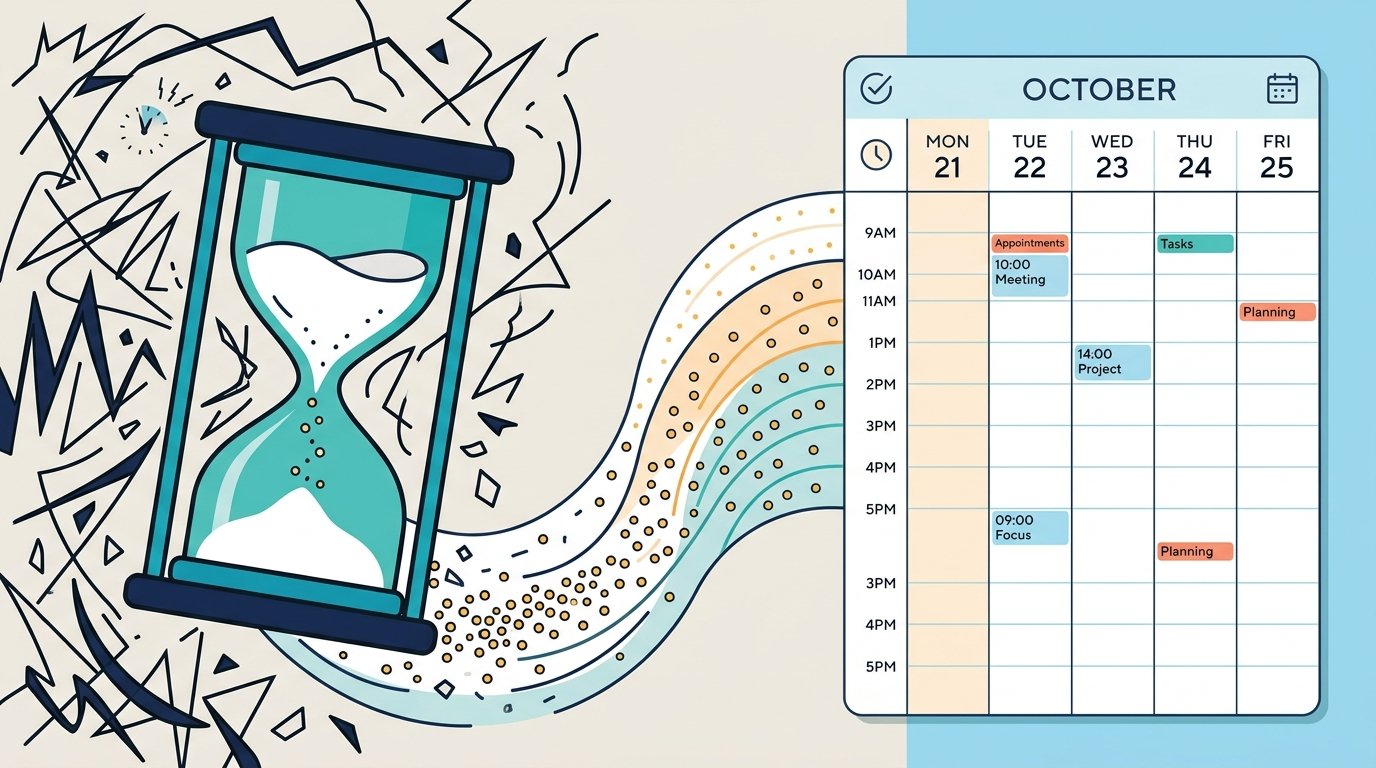
The power of the countdown: Making time your ally
Vague deadlines are the breeding ground for anxiety. When you tell yourself, "My exam is sometime next month," your brain treats the deadline as both infinitely far away and terrifyingly close. It is a paradox that leads to panic.
A countdown timer changes your relationship with time. Instead of an abstract date on a calendar, a countdown shows you exactly how many days, hours, and minutes you have left.
This might sound like it would increase your anxiety, but the psychological effect is actually the opposite. A precise countdown grounds you in reality. It strips away the scary "what-ifs" and replaces them with a clear, objective metric. You stop worrying about an imaginary future and start focusing on the actual present.
Think about it this way: a countdown timer turns a nebulous threat into a structured timeline. It tells your brain, "Here is the container of time we have to work with. It is limited, but it is manageable." Using a countdown tool to watch the days tick down helps you realize that time is a resource to be budgeted, not a monster to run away from.
Using countdowns for micro-sessions
You do not just have to count down to the day of the exam. You can also use short-form countdowns to break the daily freeze.
When you sit down to study, do not promise yourself that you will study for five hours. That thought alone triggers avoidance. Instead, set a countdown timer for just 20 minutes. Tell yourself, "I am only going to read this chapter until the timer hits zero. Once it rings, I can stop."
Almost always, the hardest part of studying is starting. By using a short countdown, you lower the barrier to entry. Your brain can easily tolerate 20 minutes of discomfort, and once you get moving, momentum usually takes over.
The study streak: Swapping panic for momentum
If countdown timers help you start, study streaks are what keep you going.
A study streak is simple: it is the number of consecutive days you have spent doing at least some schoolwork. It does not matter if you studied for six hours or 15 minutes; as long as you did something, the streak survives.
The psychology of a streak relies on a concept called loss aversion. Once you build a streak of five, 10, or 20 days, a powerful cognitive shift occurs. You stop focusing on how hard the study session is, and you start focusing on protecting your streak. You do not want to see that number reset to zero.
Tracking your daily study streak builds a visual chain of your commitment. Every day you add to the streak, you are gathering evidence of your own capability. You are proving to yourself that you are the kind of person who shows up, even when it is hard. This identity shift is the ultimate antidote to academic anxiety.

A step-by-step system to beat exam anxiety
Ready to build your own anxiety-busting system? Let’s break down exactly how to set up your countdowns and streaks for success.
Step 1: Create your master countdown
Set up a visual countdown to your first major exam. Keep this countdown in a place where you will see it daily—either on your phone's home screen, your desk, or your study wall.
- Why it works: It prevents the "ostrich effect" (where you bury your head in the sand to avoid thinking about the deadline) and gently nudges you into daily awareness.
Step 2: Define your "Minimum Viable Study Block"
To keep a streak alive, you must define the bare minimum action that counts as "studying." On a terrible day when your anxiety is high and your energy is low, what is the smallest thing you can do?
- Examples: Reviewing five flashcards, reading one page of a textbook, or watching a five-minute educational video.
- The rule: If you do your minimum viable block, your streak is safe. This eliminates the "all-or-nothing" mindset that causes so many students to give up entirely after a bad day.
Step 3: Match your countdowns with micro-deadlines
Break your study material into weekly milestones. If your exam is in four weeks and you have 12 chapters to cover, set a countdown for "3 chapters completed" at the end of week one.
- Why it works: It stops you from cramming. Cramming spikes cortisol levels, which actively damages your brain's ability to retrieve information during the actual test.
Step 4: Track the chain visually
Use a simple calendar, a whiteboard, or habit tracking apps to mark off your successful days. There is a deep, neurological satisfaction in crossing off a day and watching your streak number tick upward. That tiny hit of dopamine replaces the cortisol of exam panic.
How to handle setbacks without breaking down
At some point, life will get in the way. You will get sick, your anxiety will peak, or you will simply have a bad day and fail to study. Your streak will break.
When this happens, the "what the hell effect" often kicks in. This is a psychological phenomenon where, after a minor slip-up, we think, "Well, the streak is broken anyway, so I might as well not study for the rest of the week."
But there's a catch. One missed day is just an accident. Two missed days is the start of a new, bad habit.
To combat this, adopt the Two-Day Rule: Never miss two days in a row. If your streak breaks today, your absolute highest priority tomorrow is to perform your minimum viable study block. It does not have to be a perfect study session. You just need to get back on the board. Seeing your progress visually represented through countdowns and streaks makes it much easier to dust yourself off and start a new chain immediately.
Key Takeaways
- Procrastination is emotional, not logical: Exam anxiety triggers a fight-or-flight response. To beat it, you must lower the psychological barrier to starting.
- Countdowns anchor your focus: A visual countdown to your exam strips away vague panic and replaces it with a concrete, manageable timeline.
- Streaks build identity and momentum: Tracking consecutive days of study shift your focus from the fear of the exam to the pride of protecting your streak.
- Lower the bar on bad days: Establish a "minimum viable study block" (like five minutes of review) to keep your streak alive when anxiety is high.
- Never miss twice: If your streak breaks, use the two-day rule to restart your momentum immediately without guilt.
Using a dedicated countdown and streak tracker can transform the way you approach academic stress, turning a season of panic into a structured, step-by-step journey toward success. Start your first countdown today, study for just ten minutes, and watch your new streak begin. Your future self will thank you.
Build Better Habits — Track Your Streaks
Set goals, build streaks, and transform your life one habit at a time.