
- Published on
The 10,000-Hour Rule: Tracking Your Progress to Mastery
You have likely heard the claim that it takes 10,000 hours of deliberate practice to master a skill. It sounds like a daunting mountain to climb. Whether you want to become a fluent speaker of a new language, a master pianist, or an expert coder, the sheer volume of time required can feel paralyzing. But here is the secret: you don't need to visualize the entire mountain at once. You just need to focus on the next step.
Mastery is not an overnight event. It is the cumulative result of thousands of small, focused sessions. When you look at the 10,000-hour concept, it is easy to get caught up in the math. However, the true value lies in the process of showing up day after day. If you want to become truly proficient at something, you have to stop thinking about the destination and start obsessing over the input.
Why the 10,000-hour rule feels overwhelming
The 10,000-hour rule, popularized by Malcolm Gladwell based on research by K. Anders Ericsson, suggests that high-level performance is less about innate talent and more about the time invested in "deliberate practice." Deliberate practice is not just doing something repeatedly; it is focused, structured activity aimed at improving specific weaknesses.
The problem for most of us is that we lack a feedback loop. We practice, we get tired, and we lose track of how far we have actually come. Without a way to visualize our progress, we assume we aren't moving forward. This is where the psychology of small wins kicks in. When you can see the data behind your efforts, your brain releases dopamine, which reinforces the habit and makes you want to show up again tomorrow.
The power of tracking your journey
If you want to reach mastery, you have to treat your time like a currency. You are spending your life hours on a specific skill, so why wouldn't you track the investment? Many people fail because they treat practice as a vague "sometime" activity. They say, "I'll practice guitar when I have time." Predictably, time rarely appears.
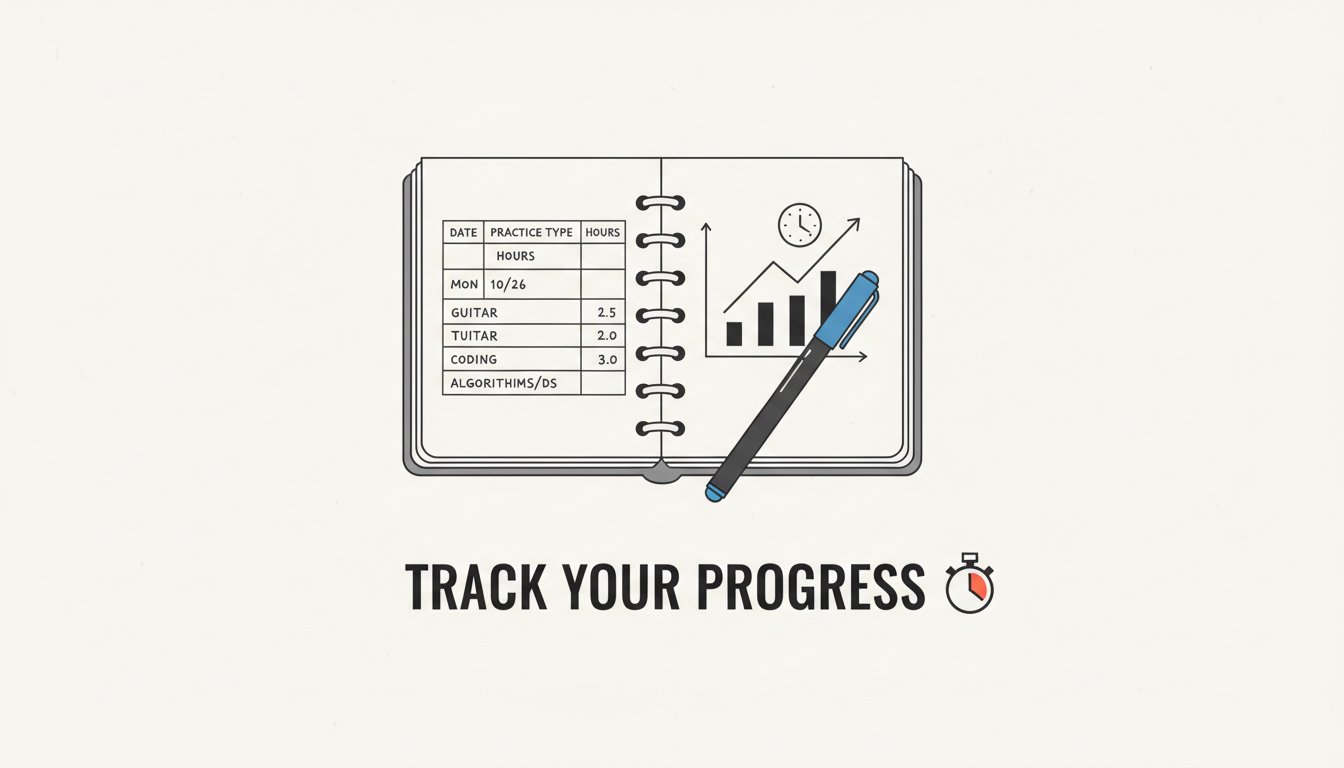
Instead, start tracking your hours. When you use a manual or digital log to record your practice sessions, you transform a vague goal into a concrete metric. Seeing that you have logged 50 hours toward your 10,000-hour goal provides a massive psychological boost. It moves the needle from "I'm trying to learn" to "I am actively building a skill."
Defining deliberate practice for beginners
Deliberate practice is different from "playing around." If you are learning to write, spending an hour typing aimless diary entries isn't necessarily deliberate practice. Spending an hour focusing specifically on sentence structure, vocabulary expansion, or editing techniques is.
Here is how to structure your practice:
- Identify the gap: What is the one thing you currently struggle with in your chosen skill?
- Set a micro-goal: Spend 30 minutes focusing only on that specific element.
- Record the time: Keep a simple log of how many hours of focused, deliberate effort you put in.
By narrowing your focus, you make the 10,000-hour goal feel like a series of small, manageable chapters rather than one endless, exhausting book.

How to stay consistent when progress feels slow
There will be weeks where you feel like you aren't improving at all. This is often called "the plateau," and it is where most people quit. They look at the massive gap between where they are and where they want to be, and they lose motivation.
You can counter this by focusing on your streaks. When you maintain a streak of consecutive practice days, you are building an identity as someone who does the work. Using a tracking tool to monitor your consistency helps you realize that even on your "bad" days, you are still moving forward. A 15-minute session is infinitely better than a zero-minute session. It’s not about the intensity of one day; it’s about the consistency of a thousand days.
Remember, if you are struggling with the mental burden of your goals or feeling overwhelmed by the pressure to perform, please reach out to a professional or a trusted person in your life. Growth should be a rewarding process, not a source of constant anxiety.
Small steps to your first 100 hours
You don't need to worry about hour 9,999 today. Your primary focus should be reaching your first 100 hours. Think of this as the "foundation phase." During this time, you aren't looking for perfection; you are looking for familiarity.
Try these three steps this week:
- Audit your schedule: Find one hour each day that you can dedicate solely to your craft.
- Remove distractions: Put your phone in another room. Deliberate practice requires your undivided attention.
- Log the session: Once you finish, mark your time in a dedicated tracking tool. Seeing your total hours climb provides the visual evidence you need to keep going.
Tracking your progress makes the abstract idea of "mastery" feel real. When you look back at your logs and see the weeks and months of consistent effort, you stop wondering if you are improving and start knowing that you are.
Key Takeaways
- Mastery requires deliberate practice: It is not about the number of years you spend, but the number of hours of focused effort you put in.
- Track your investment: Use tracking tools to log your hours. Seeing your progress in numbers keeps you motivated and provides a sense of accomplishment that helps you push through plateaus.
- Consistency beats intensity: A short, focused session every day is more effective for long-term growth than an infrequent, intense marathon session.
- Focus on the next chapter: Don't let the 10,000-hour goal paralyze you. Focus on reaching your first 100 hours by breaking your learning into small, actionable steps.
- Visualize your growth: Using a streak tracker or a progress log can help you stay consistent. Seeing your progress add up day after day is one of the most powerful ways to maintain the discipline required to reach your goals.
Build Better Habits — Track Your Streaks
Set goals, build streaks, and transform your life one habit at a time.